Screaming Eagle Winery
From LoveToKnow Wine
A Wine Cult with Talons and Drama
Need a definition of a cult wine? Perhaps this will help: a high quality wine produced in miniscule quantities that people with grandiose disposable incomes buy at over-the-top prices and either consume themselves or resell at an even higher price to other people with even larger disposable incomes. Hopefully, the wines are even good. One of the better-known examples of a cult wine would be Screaming Eagle, any vintage. It has been the default wine with celebrity buzz ever since the first vintage of 1992 was released in 1996. Good luck trying to find any; there were only 225 cases produced. Now, it's not easy to become a cult wine: planets and stars must align, fates must converge, and karma must be kind to the vineyard and the winemaker. Actually, this same confluence of fortune must befall on the buyer of a cult wine and the people they deem worthy to share a taste of this hard-to-get and hardly-can-afford rarity of a wine with. For Screaming Eagle, the planets, the fates, and karma have been generous.
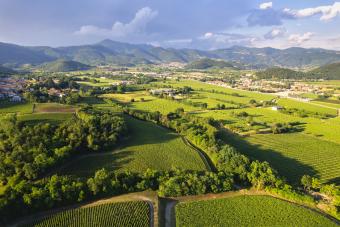
Screaming Eagle is a reclusive and private boutique winery in Napa Valley's Oakville AVA and just off the Silverado Trail near the junction with Oakville Crossroad. In the 1990s it became the darling of those conspicuous consumers addicted by its allure and the status of owning and drinking a Screaming Eagle. The winery began inauspiciously from a winemaking experiment by a real estate broker, made in a rubber garbage can, tasted and endorsed by Mondavi staff, and was named Screaming Eagle out of moxie and unfettered audacity to make the best wine possible.
Screaming Eagle's Startup to Fame
Jean Philips, together with Tony Bowden, founded the winery in 1986 when they acquired a plot of land with less than sixty acres planted in vineyards, predominantly in white varietals. Nothing personal against white wine, but over time, these were pulled out and Cabernet Sauvignon was planted with a small amount of Merlot, and Cabernet Franc for a Bordelaise blend. In the beginning, all grapes were sold to other wineries around Napa Valley. But Philips began experimenting with making wine on the side. She solicited winemaking advice from veteran scientist-winemaker Richard Peterson and his daughter, Heidi Peterson Barrett. In 1992, Philips held back one acre of grapes for the first vintage and the cult of Screaming Eagle began.
Heidi Peterson Barrett
It takes a cult winemaker to make a cult wine. In Screaming Eagle's case, that would be Heidi Peterson Barrett. At the time she joined Jean Philips at the winery she had already built a stellar reputation as the winemaker at Buehler Vineyards and had crafted the Maya at Dalla Valle Vineyards, another one of those cult wines. With her success at these wineries, Ms. Barrett created a heavyweight reputation for herself. You could call her the Cab Queen of Cult Wines because she holds dominion over this majestic grape. She also consults with other wineries such as Amuse Bouche, Jones Family, Barbour Vineyards, Paradigm, Showket, and Revana. Her past clients include Grace Family, Vineyard 29, Hartwell, and Oakford Vineyards. Her winemaking strategy is to combine traditional and modern scientific methods to make wine and to maximize an estate's potential to create a balanced and high-quality wine. Results count and it would be hard to imagine Screaming Eagle's success without Ms. Barrett.
Wine's Pedigree
Year in and year out, a Screaming Eagle scores high by Robert Parker, even hitting the 100-point rating on occasions ('92 and '97), and rates from the mid-to-high 90s in Wine Spectator. Typically the winery produces around 500 cases made from grapes from the Screaming Eagle section of the vineyard. It's a blend of Cabernet Sauvignon with minor amounts of Merlot and Cabernet Franc and aged in American and French oak. In general, Screaming Eagle wines are known as dramatic and plush with concentrated berry-cherry-cassis fruit, complex and layered with floral, spice, and oak flavors. One can expect a rich and intense wine with a deep but well-balanced structure that exhibits elegance and refinement from start to its lingering finish.
How Much Does Status Cost?
Sounds pretty good, yes? Uh-huh. But how much does it cost to get one of these status-rendering cult wines? The first 1992 vintage was priced at $50. A great price if one was a friend of Ms. Philips or Ms. Barrett and got one through the back door, or hit the mailing list lottery and was eligible to buy directly, or was one of the winery's restaurant customers. Otherwise, the price would rise as precipitously as an Internet stock during the dotcom boom. Currently, a bottle costs $300, with customers allotted a maximum of three bottles. However, Screaming Eagle only produces 500 cases per year so there's not a lot to spread around. Don't expect to pay that price if you're not on the list.
How do you get it?
Where you won't find it: Costco, Trader Joe's, or 7-11. If you're not on the mailing list, about the only place to find a bottle might be at a luxury restaurant or through a wine auction. And that's where the price gets ratcheted up into the stratosphere, easily reaching over $1,000 at a restaurant and two or three times higher at auction. By the way, Screaming Eagle's mailing list is maxed-out...as well as its waiting list. But if you are motivated to find a bottle there are a few paths to follow to get a taste. First, go to a restaurant like Le Cirque in New York that has a high-end stellar wine list. Second, try wine auctions, either at major auction houses like Christie's or Sotheby's or specialized wine auction websites that abound on the Internet. Third, there are a handful of wine dealers with mysterious sources who are happy to sell them at ransom prices. The fourth, and possibly best way, nurture a friendship with someone who has a bottle and likes to share.
What Pushes the Cost Up?
The simple answer is a driving demand fueled with wealth and desire for status frustrated by a minuscule supply. The price is primarily pushed upward due to second-tiered auction channels where private individuals can sell their wine. As you are by now aware, the bulk of Screaming Eagle is sold direct via their mailing list with a three-bottle limit. Typically, the mailing list customer will buy their limit and then sell one to two of their allocation as a finance vehicle to cover their investment cost and to buy other wines. Many may buy and hold to wait for future demand. A few may actually drink it. Excuse me, taste it.
Is a Screaming Eagle Really Worth It?
This is a point-of-view answer. If the price doesn't make you blink then tasting a Screaming Eagle can be a revelatory experience. If a $2,000 to $3,500 price tag causes you to gasp or to giggle at the absurdity, then no matter how exceptional the Screaming Eagle is you won't enjoy it and you will pause in wonder at what the big deal is. In either case, the world is full of wines that are delicious, that won't punch a black hole in your bank account, and that provide a higher level of util satisfaction.
Sold
Newsflash—in March, 2006, Jean Philips sold Screaming Eagle to Charles Banks and his business partner, Stanley Kroenke. Banks is the president of CSI Financial Capital and Kroenke is probably better known as a sports franchise owner. He is the owner of the Denver Nuggets basketball team, the Colorado Avalance hockey team, and part-owner of the St. Louis Rams football team. No plans were announced for a new Screaming Eagle wine-drinking team but the new owners have stated that they plan to continue operating the winery according to Jean Philips' mission. This would include facility improvements as well as vineyard redevelopment. No announcement has been made regarding the winery's star winemaker, Heidi Peterson Barrett, but the new owners have stated their commitment and desire to retain her services. Financial terms were not publicly disclosed but based on the price of a bottle of Screaming Eagle; no doubt it wasn't at a discount.
No Tours, No Tasting
Planning a Napa wine tour? Don't bother to put Screaming Eagle on your itinerary, it's not open to the public for tours or tasting. Its address is listed as a P.O. Box which doesn't have a tasting room either.
Other Cab Cult Screamers
- Araujo Estate Eisele Vineyard, Cabernet Sauvignon
- Bryant Family Vineyard, Napa Valley, Cabernet Sauvignon
- Colgin Cellars, Herb Lamb Vineyard, Cabernet Sauvignon
- Dalla Valle Vineyards, Maya
- Grace Family Vineyards, Napa Valley, Cabernet Sauvignon
- Harlan Estate
- Shafer Vineyards, Hillside Select, Cabernet Sauvignon
The above are some of the traditional Cabernet Sauvignon-based cult wines that emerged over the last decade. Some may have slipped in status, and new ones may have popped up, but none have been bumped off the list. One reason Cabernet Sauvignon is behind the bulk of cult wines is its propensity to consistently age well as compared to Pinot Noir, Syrah, or white varietals. Other countries should not be ignored or dismissed either. A Haut-Brion from Bordeaux can go toe-to-toe with a Screaming Eagle any day. That would be an interesting side-by-side tasting, if for no other reason than just to check out who bought the wines.
This page has been accessed 10,446 times. This page was last modified 17:52, 21 June 2006.
© 2006-2008 LoveToKnow Corp.