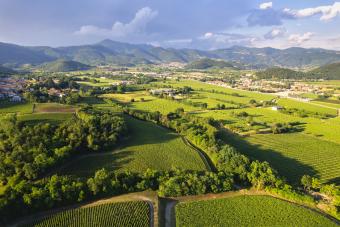
Chateau Mouton Rothschild

From LoveToKnow Wine

Just Another Hand-Me-Down Family Business

Speak of Bordeaux and think of wine. Speak of Rothschild and think of wine and banking...or vice versa. Mayer Amschel Rothschild got the family's financial ball rolling in the ghettos of Frankfurt, Germany in the 1760's as a coin and currency dealer. And so began the House of Rothschild. There were five sons that fell into the family business, eventually leaving to start banking houses in Paris, London, Naples, Frankfurt, and Vienna. Along their way in the rags-to-riches Rothschild story, a de was inserted before their surname as an aristocratic affectation in France with Baron titles later bestowed upon their mantles in Austria and England. A turning point in the House's finances emerged during the Napoleonic Wars when the Rothschild brothers financed the Duke of Wellington's campaign against the half-pint Bonaparte. When Napolean's army went down at Waterloo, the House of Rothschild's wealth soared in the other direction. The Rothschilds made a lot of excellent and rewarding investments over their generations. Wine may not have reaped the biggest ROI, but over time the family has done very well by it. Besides, the value of wine cannot always be measured in monetary terms. Financiers sometimes get confused with these concepts, but the Rothschilds somehow found a way to accommodate and accept these uncompromising notions.

Bordeaux Beckons and a Wine Empire Begins

Wine entered the Rothschild's picture in 1853 when Nathaniel (Nat) de Rothschild of the London Rothschild branch (grandson of Mayer Anschel Rothschild) acquired Château Brane Mouton. This was a well-known wine estate in the Medoc region of Bordeaux, 50 km (30 mi) northwest of Pauillac on the west bank of the Gironde River. Upon acquisition, Nat, as common practice of the time, changed the name to reflect the family name to Château Mouton Rothschild. It was a buyer's market for vineyard real estate at that period as well. Most of the region was being damage by the oidium mildew and the wine industry was tenuous. Château Brane Mouton did not have a reputation of note, and its acquisition by Nat Rothschild may be viewed either as success by falling into it, as the family probably thinks, an astute investment.

Not to be outdone, Nat's uncle, father-in-law, and boss, James Mayer de Rothschild, compelled perhaps by competition with his nephew, son-in-law, and employee, bought Château Mouton Rothschild's neighbor, Château Lafite in 1868. This estate was significantly larger than Mouton and planted seeds of rivalry within the family that seems never to wither.

The Bordeaux Official Wine Classification of 1855

This was a bad year for Château Mouton-Rothschild. Emperor Napolean III requested a classification of Bordeaux's wine estates the 1855 Exposition Universelle de Paris. This was a world's fair and it represented a chance to showcase France's best. A group of wine brokers and experts were called in to make the classifications. The wine estates were ranked from first to fifth growths or crus. All first growths were from the Medoc region and there were four. Unfortunately, Mouton Rothschild was denied entry to this elite circle, but was relegated to the second growth, albeit at the top of the second-tier. The Château has always viewed this as more than a slight, but rather as an injustice. Although perhaps a biased opinion, the family has felt that the estate belonged to the First Growth. Everyone likes a good conspiracy theory, and there is one that proposes the unfair ranking was due to the French judges not wishing to place an estate owned by a British subject in the first growth. But although the Rothschilds grumbled and bemoaned the ranking, they let it rest in 1855. Why is this ranking important? Reputation and pride would be one reason, but more importantly, with reputation also come price and a First Growth rank will always bring a premium in the market. Château Mouton Rothschild would have to make due with its Second Growth price tag. This would change later.

Baron Philippe de Rothschild

Baron Nathaniel de Rothschild nor his offspring showed any aptitude or profound interest in the estate or the wine business. Consequently, Château Mouton Rothschild languished with limited active family involvement for three generations until the year 1922. That year, Nat's great-grandson, the 20-year old Baron Philippe arrived at the family estate and took charge. The Baron Philippe combined vision and ambition for the Château and wine. The culmination of this was to produce one of the world's greatest wine estates and greatest wines. From the beginning, the ambitious Baron Philippe challenged the status quo of Bordeaux, both winemaking practice and its 1855 Classification. This is evidenced in the Château's motto, "Premier ne puis, Second ne daigne, Mouton suis" (First I may not be, Second I will not be, Mouton I am.) Throughout his lifetime, Baron Philippe's influence in the wine world, both new and old, can not be overstated.

Highlights under Baron Philippe de Rothschild's Leadership

  • Initiated poster art labels starting in the 1924 vintage with the first by art deco artist, Carlu. Shocking at the time, labels were to provide information about the wine in the bottle, not art.
  • In 1924 Baron Philippe also was the first to introduce estate bottling putting the Mis en Boteille au Château on the label, an unheard of practice.
  • In 1926, built the Grande Chai, a 100-meter hall that can store up to 1000 barrels.
  • Introduced the Mouton Cadet brand in 1932. Originally produced from the estate vineyards, this would become a negociant wine, produced from blended grapes from other vineyards in the Bordeaux region. Good ideas last, Mouton Cadet is the world's leading selling brand today.
  • Acquired Fifth Growth Estate, Château Mouton d'Armailhacq, in 1933. This is first of several estates added to the estate's holdings.
  • Puts a "V" for victory on the 1945 label to announce the estates survival. Continues to put emphasis on the wine's label as a marketing tool by having artists like Bracque, Miro, Moore, Chagall, and Dali paint them. Payment is traditionally with five cases of the vintage.
  • Comes in second to Napa Valley's Stag's Leap 1973 Cabernet Sauvignon at the Paris Wine Tasting of 1976—Perhaps second to Napa but not quite as scandalous as the other French that followed.
  • In 1979 Baron Philippe joined with California's Robert Mondavi to create Opus One.

"Premier je suis, Second je fus, Mouton ne change"

"First I am, Second I was, Mouton does not change." The Rothschild persistence pays off—In 1973 after years of lobbying, there was a change to the 1855 wine classification; Château Mouton Rothschild became a First Growth.

Baronness Philippine de Rothschild

The Baron passed away in 1988. His sole surviving child, Philippine, is running the show and expanding upon the Château's reputation, promotion, capacity, and influence in the wine world. The Baronness has diversified the estates' holdings in Bordeaux and other parts of France, committed to other partnerships in South America (Concha y Toro), and expanded the brands Mouton Rothschild offers while holding firm to her father's vision and regard for quality.

The Essence of Château Mouton Rothschild

There is more than the art on outside of a Château Mouton Rothschild bottle, but also the wine inside. Mouton exemplifies the essence of a Pauillac wine—weighty but with finesse. These are deep, dark black wines with rich concentration, aromatics, and subtle complexity. Expect to age from 20-60 years.


Comment on Chateau Mouton Rothschild


(Displayed with your comment)                        (Will not be displayed)
Verification Code:   
    

Wine


E-Mail Updates

Sign up for a free LoveToKnow e-newsletter to get exclusive recipes, decorating tips and great information you need!

Receive offers from our partners.

Read our privacy policy.


PRINT THIS PAGE

EMAIL TO FRIEND


You are here: LoveToKnow » Home, Garden & Events » Wine » Wineries » Chateau Mouton Rothschild