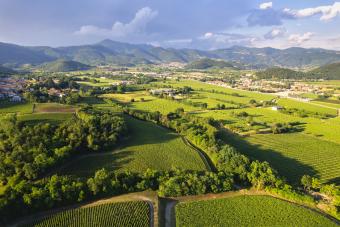
Chateau Lafite Rothschild
From LoveToKnow Wine
Château Lafite's Beginnings on a Hill
There have been five generations of Rothschilds that have owned and operated arguably, the most famous First Growth wine estate in Bordeaux. But Château Lafite existed before the Rothschilds acquired the Medoc historical estate in 1868. Lafite in the Château's case is derived from a Gascon word, la hite, meaning a small hill. Naturally, the estate's stately manor is perched prominently on a knoll overlooking its vineyards and Pauillac. And although there were known vineyards planted in the hills and plateaus of Lafite, it wasn't until the Sègur family in the 17th century inherited the property that the wine estate began gaining prominence. Coincidentally, the Sègurs also added Château Latour to their wine fiefdom via marriage of Alexandre de Sègur to Marie-Thérèse de Clausel, the daughter of the second husband of the woman who owned Château Latour. Their progeny, Nicholas-Alexandre, became known as the Wine Prince due to his proclivity to acquire wine estates. During his lifetime, he acquired Château Mouton and Calor, and when combined with Lafite and Latour gave him a quasi-monopoly of the best estates in Bordeaux. But death is superior to Sherman Anti-Trust Laws in breaking up monopolies. With the Marquis' death in 1755, the consolidated wine empire began unraveling and the different estates were broken up over time. Lafite went to the Count Nicholas Marie Alexander de Sègur, the son of the Marquis Nicholas-Alexandre's oldest daughter. The Count was apparently only good at producing debt, and in 1784 sold Château Lafite to repay them.
The King's Wine
Back in the day of King Louix XV, the wine of the French Royal Court was Château Lafite. King Louis got hooked on Lafite's red claret via Maréchal Richelieu, the Governor of Guyenne. A doctor had prescribed Lafite to Richelieu as a tonic; thereupon to solicit favor of the King, he introduced it to Louis XV as a rejuvenating "Fountain of Youth." Lafite became the elixir of choice at the Palais de Versailles. King Louis XV lasted until the age of sixty-four but alas, Château Lafite failed to ward off the smallpox that terminated his life.
Convolution Continues
When Château Lafite was sold to pay off the Count Nicholas' debts, it fell into the hands of Nicholas Pierre de Pichard who had the inside track due to his position as President of the Bordeaux Parliament, and being a relative. Pity, the aristocratic and wealthy Pichard eventually landed up on the scaffold and a date with Madame Guillotine during the Reign of Terror. Thereupon, Château Lafite was confiscated by the state and sold at auction in 1797. A Dutch consortium picked up the wine estate in 1799, which then turned it around in 1803 and sold it to another Dutchman, Ignace-Joseph Vanlerberghe. What ensued was a succession of owners over the next half century. Eventually, it passed to Samuel Scott of England who theoretically and mysteriously owned Lafite until 1867. That year, during an inheritance inquiry with Vanlerberghe's son, Scott's supposed ownership was revealed as invalid. Scott sold Lafite to pay the fines and make restitution. The property went up for sale, and although there was hotly contested bidding, Baron James de Rothschild of the Paris arm of the Rothschild finance empire took over Lafite. Finally, Bordeaux's most famous wine estate came to rest as Château Lafite-Rothschild.
First of Firsts—the Classification of 1855
The Bordeaux Wine Official Classification of 1855 for the 1855 Exposition Universelle de Paris was a classification by the wine industry to rank the best châteaus by reputation, price, and ultimately, quality. Four were ranked as First Growths. Of these, Château Lafite was declared first, at the top of the list. It was now official and difficult to dispute.
Baron James de Rothschild Enters and Exits
The year is 1868, Baron James takes over Château Lafite and the estate becomes part of the Rothschilds. Coincidental or not, the estate borders Château Mouton Rothschild that his nephew and son-in-law had bought in 1853. But the Baron had little time to savor his investment or event to uncork a bottle, Baron James didn't last out the year, succumbing three months after the purchase. Besides leaving his de Rothschild Frères banking legacy, more importantly for the wine industry, Lafite passed to the Baron's heirs, Alphonse, Gustave, and Edmond. There followed a fifteen year period of remarkable vintages during the "Golden Age of Médoc" that helped solidify the 1855 ranking as a First Growth, and the Rothschilds have rarely looked over their shoulders since.
Fifth Rothschild Generation in Charge
There have been challenges and threats to Lafite through the ensuing years. There have been invasions of oidium, phylloxera, and Germans during WWI, and then WWII with occupation and plundering by the Hitler's Third Reich. Yet, through generations of Rothschild stewardship, Lafite has endured, expanded, and ultimately thrived. Baron Eric de Rothschild took over management of the family's wine business in 1974, the fifth generation of Rothschilds to do so. During his reign, Baron Eric has successfully guided Château Lafite-Rothschild through vintage years, estate renovation, vineyard expansion, and acquisition of key wine estates, such as Chile's Los Vascos and others in France and Portugal. He also joined forces with other industry leaders, creating strategic partnerships with the Chalone Wine Group in California, Nicholas Catena in Argentina, and Castellare di Castellina of Tuscany. Baron Eric also expanded Lafite's consumer range by creating the DBR brand line. These are wines that are more immediately accessible for daily consumption, or at least by most people, and are red and white from various vineyards in the Pauillac, Medoc, and the Bordeaux region.
The Château Lafite-Rothschild Style
Pauillac in the Haut-Médoc defines Bordeaux and is considered the best appellation in the region. In fact, of the five First Growths, three of them are Pauillac. These include Château Latour, Château Lafite-Rothschild, and the family rival, Château Mouton Rothschild. Note that this family rivalry is sometimes considered friendly and sometimes considered contentious. Wines from Pauillac tend to be dark, almost inky, that imparts black currants, cherries, spice, cedar, complexity, and ultimately elegance and opulence. Lafite-Rothschild's style leans to a softer tone than Latour or Mouton, and exhibits artful finesse. Château Lafite-Rothschild is usually blended 70% Cabernet Sauvignon, 20% Merlot, 5% Cabernet Franc, and 5% Petit Verdot. Ages 10-25+ years. Live long and prosper.
Learn More
This page has been accessed 9,662 times. This page was last modified 03:12, 16 June 2006.
© 2006-2008 LoveToKnow Corp.