Beaulieu
From LoveToKnow Wine
Napa's Beautiful Place
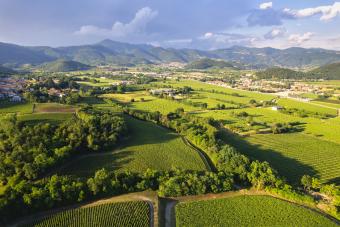
If one took Beaulieu Vineyards (BV) out of Napa Valley and California wine history there would be a massive void, one large sucking abyss of a hole. The winery's history began in May of the new century, not this one but the last one, in the year of 1900. Georges de Latour bought a small 4-acre parcel of land with a house on it in Rutherford, smack dab in the middle of Napa Valley. Whether knowingly or just fortuitously, Latour happened to acquire a spot in traditionally the best terroir in Napa Valley, and by default, in California. As a surprise he presented the small plot to his wife, Fernande, and according to the winery's history, she is the one who called it a beautiful place, "Quel beaulieu!", meaning a beautiful place. True or not, the name stuck and Beaulieu Vineyards was born. And while there were other older, noteworthy, and historic wineries in the Valley at the time, Charles Krug, Beringer, Schramsberg, and Inglenook to name a few; Latour and Beaulieu Vineyards made its mark and built its reputation as innovative, entrepreneurial, and a producer of some of the Valley's best wines.
Phylloxera Doesn't Bug Beaulieu
Phylloxera is a nasty little aphid that nearly wiped out France's wine industry in the late 1800's. The pest hitchhiked its way to Europe via some American vines and thereupon spread, destroying much of the continent's vines by infesting their roots. The ultimate solution to eradicate this Attila the Hun pest was to graft vines on to American rootstocks that resisted the phylloxera. There is irony here and it is not lost on the wine world, American vines brought the bug to Europe and American vines saved Europe's wine industry. This bit of irony went up a notch when Mssr. de Latour became the first to import the phylloxera-resistant varietals from France to the United States. Over the next decade, Latour imported thousands of these varietals for BV and also sold to other wineries as well. His action literally save the Napa Valley and California's wine industry from this scourge.
How to Make Wine and Survive during Prohibition—Legally
The Volstead Act passed in October of 1919 enforced the 18th Amendment and made it illegal to manufacture, sell, or transport intoxicating liquor. Obviously this would be bad for business if your business was making wine. Prohibition was a steamroller—flattening and devastating many of the country's best wineries. But not BV, it actually thrived during this period of enforced temperance by contracting to supply Sacramental Wine to churches across the country. This was a niche market that Latour identified and produced wine for starting in 1910. An interesting to note that church attendance rose dramatically during the years 1919 to 1933, not that there's a direct correlation to Prohibition and BV. However, at the time when the 21rst Amendment repealed the 18th, Georges de Latour was a wealthy man and BV was a modern and growing winery. In fact, during this countrywide on the wagon phase, BV continued making regular non-sacramental wine and aging it in the BV cellars, improving his single varietals and creating premium table wines of excellent quality. He increased his acreage, emphasized quality over mediocrity, and put his passion into his wine. The forward-thinking Latour had his Cabernet Sauvignon ready to go without missing a beat.
World Class Wine and André Tchelistcheff
Mssr. de Latour's passion was to produce quality wine comparable to the French. After the hibernation of Prohibition ended, BV began a methodical drive to produce world-class wines from Napa Valley. Imitation is supposedly the highest form of flattery. To flatter the French, Latour recruited a Russian, well actually, a Russian émigré enologist working at the Institut of National Agronomique, André Tchelistcheff. And please, don't ask me how to pronounce it. Pronouncing his name isn't as important as understanding the impact Tchelistcheff had on BV and the entire United States' wine industry. He became the Maestro, the Father of California winemaking, and the mentor to countless viticulturists and winemakers. Tchelistcheff became BV's winemaker from 1938 up to 1968 and during that time he created the style not only of BV, but also of California wine itself and Cabernet Sauvignon. He introduced technique and methodology to the vineyards and the winery, helped create the sense of terroir to Rutherford and the Valley, and helped develop other wine regions within California, Washington, and Oregon.
Georges De Latour Private Reserve and Others
BV is the leader of Cabernet Sauvignon clones and is the most collected Cabernet Sauvignon producer in Napa Valley. The reason? Primarily it is because of the foundation that Latour and Tchelistcheff have built at BV. Latour's goal was to make wines comparable to the French. He imported French vines, brought in a French-trained enologist, and then began producing premium wines. In 1938, BV introduced their first George De Latour Private Reserve. This is the wine with big shoulders that BV and its reputation sits on. It's the U.S. wine that most closely resembles a First Growth Bordeaux. The 100% Cabernet Sauvignon does what most other California Cabs dream of doing, combines the hugeness, concentration, intensity, and complex structure of a Napa Valley Cabernet but miraculously combines that with the refinement and finesse of great French Bordeauxs, truly the best of both worlds. On top of BV's stalwart flagship, the winery has built a broad spectrum of wines that cover all bases, from the top-tier to everyday value-priced wines.
Reserve Wines
The Reserve Wines express Beaulieu Vineyards' best—always excellent, often memorable.
- George de Latour Private Reserve® Cabernet Sauvignon
The most collected Napa Cab and never a bad choice. This is one to keep in the cellar and ages well.
- Tapestry
This wine is a Bordeaux-type blend of Cabernet Sauvignon, Merlot, Petit Verdot, and Cabernet Franc.
- Dulcet
A reserve blend of Cabernet Sauvignon and Syrah.
- Reserve Pinot Noir
Produced from BV's best Carneros vineyards.
- Reserve Chardonnay
Also from BV's Carneros vineyards. Lightly oaked.
- Clone 4
This is a limited production, handcrafted Cab that gets special attention from the BV winemakers. Built for the cellar.
- Clone 6
Another unique Cab clone that's big and chewy. Also handcrafted with limited production and built to cellar.
Napa Wines
This is a group of single varietals from BV's vineyards in the Napa Valley. This includes Cabernet Sauvignon (Rutherford), Carneros Chardonnay, Carneros Pinot Noir, Napa Cabernet, Napa Merlot, Napa Chardonnay, Napa Zinfandel, Napa Syrah, and Napa Sauvignon Blanc.
Signet
This group is designated for the restaurant trade and includes Cabernet, Merlot, and Chardonnay. Wines are from the Central Coast or North Coast
BV Coastal
This group represents great value red and white wines from selected vineyards in the Central Coast and North Coast.
Beaulieu Vineyards — No End in Sight
This is the second century for Beaulieu Vineyards. They are one of the leaders in the California wine industry, hold a prominent position in the industry's history, and continue to innovate and look forward. The winery continues to stand for quality wines, bold vision, dedication, and passion that have been the founder's standard. Beaulieu is still beautiful.
This page has been accessed 9,925 times. This page was last modified 19:49, 27 January 2008.
© 2006-2008 LoveToKnow Corp.