Barbera
From LoveToKnow Wine
Barbera has endured decades of begrudged tolerance among winemakers and wine lovers alike, a grape easily dismissed as undeserving of respect or adoration.
Barbera, the Rodney Dangerfield of Italian Wine
Respect is rarely automatic, not always deserved and not taken lightly. Barbera has lacked respect in the wine world because it was said to be too acidic, too rustic, too coarse, lacking flavor and compromised too easily. Barbera's only apparent redeeming quality was its cheapness or more modestly put, its value. Perhaps it has had a bad reputation because it is a primary Piedmont resident in Italy's northwest wine region, where the other two grape varietals, Nebbiolo and Dolcetto, overshadow the lowly Barbera in respect and admiration. It's grown in other Italian wine regions, in fact, after Sangiovese, Barbera is the second most planted grape in the boot-country, but there's no correlation with that fact and that people love and praise their Chiantis, their Brunellos, and their Barolos more. While Barbera has been sneered at, spat upon and spurned, bottles of it are commonly found as the table wine in Italian restaurants. What do they know that the snooty critics don't? Barbera may be underrated, but it's the everyday underrated drinking wine.
At Home in Piedmont
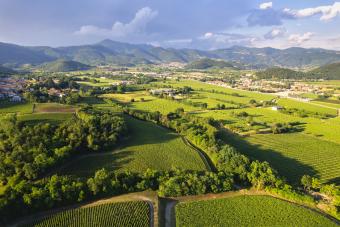
The wines people think of when Piedmont is discussed are Barolo, Barbaresco and Dolcetto. They deserve their kudos, no question about their worthiness. Barbera's reputation for creating lackluster character, dearth of flavor and biting acidic wines has started to wear off. The wines deserve a chance. In general, the best Barberas are found in the Piedmont.
Without question Barbera's will probably never rise to the stature of Barolos or Brunellos, but winemakers are getting wiser in their approach to and handling of the grape. They are planting the vines in better sites, reducing yields and paying more attention to wine production. Longer aging in oak has proven effective to enhance Barbera's spartan character, bring out flavor, and build balance in structure.
For decades Barbera has suffered under neglect and lack of attention, but the new style is bringing out the richness in the fruit that in turn balances the grape's inherent acidity. The result is a Barbera that many years ago would not be recognized. Ironically, in the Piedmont Barolo's gets the accolades but Barbera outplants the Nebbiolo grape by about fifteen times. Part of the reason might be attributed to Barbera's hardy knack to grow profusely in places other grapes whine and moan and then wither and die.
There are five D.O.C. in the Piedmont for Barbera but there are only two that should get your attention, the best to check out are:
- Barbera D'Alba
- Barbera D'Asti
Barbera Defined
Contrary to Barolo or Barbaresco, a Barbera wine is not a dark and sinister purple but a brighter ruby red. Also, Barbera has negligible Tannic tannins and does not age as well. It's probably a good idea to drink the wine when it's fairly young, say within four to six years of the vintage date. As it ages, the color will turn to garnet with brownish edges. Regarding its flavors, when expertly done, Barbera shows modes of black cherries, black berries, currants and plums.
Styles of Barbera
There are essentially two types or styles of Barbera, the pre and post wines. The pre is made in the tradizionale method before the accademico metodologia influenced how the wine is made. Like all Italian politics, there is always opposition. The pre Barbera is simple in structure with spare fruit character that is accentuated with an sharp acidic tang. This is not a knock on the wine but rather an acknowledgment of its nature. The post Barbera will exhibit more extracted fruit, density, and an indication of oaky tannins to provide a counterweight to the fruit's natural acidity.
Barbera and Food
Why, with all the great Italian Barolos, Barberescos, Brunellos, Chiantis and Super-Tuscans, is Barbera so popular? Simple, food. The problem with a lot of fruit-bomb wines is the lack of acidity, which makes it an inspirational and creative task to match with food. Barbera is easy. The wines have good acidity to make it a natural and flexible grande amico with food, particularly with pizzas, pastas, grilled poultry and meats, and a slice of prosciuotto, Reggiano Parmigiano and pane rustico.
California and Barbera
California is another popular region for Barbera, but the acreage has been declining during the last decades and the grape is generally used for blending, making a California version an anomaly with quirky interest. But hey, it's California, quirky can be good.
Best Barbera Regions
As mentioned above, the best Barberas will probably come from Barbera d'Alba or Barbera d'Asti and these wines are predominantly made from 100% Barbera grapes. In other areas it tends to be blended to offset some of the grape's natural limitations. The following are just a few that consistently stand out. Note that many are excellent Barolo producers that also make Barberas. If you fancy a particular winery and their Barbera, push the envelope and try their Barolo...and vice versa. Regarding price, the tavola version will run about $10-$12 but the complex Barberas that express themselves with their hands like a true Italian will cost between $15-$35.
- Agostino Pavia & Figlia.
Wine: Bricco Blini, Barbera d'Alba. Price: $12. A straightforward Barbera that will show balance of berry fruit, acidity, depth and a dearth of tannins. Shall we say, "Large—Pepperoni and mushrooms, extra cheese."
- Domenico Clerico
Wine: Barbera d'Alba Trevigne. $25. Clerico is located in Monforte d'Alba, producing mostly Barolo wines. He also makes an outstanding Barbera from three vineyards and ages in French oak. Clerico wines are highly prized as his full-bodied Trevigne.
Wine: Barbera d'Alba "Ciabot du Re", Barbera d'Alba. Price: $20-$40. The "Ciabot du Re" is the one to look for from Fratelli Revello. It's released after two years of harvest and shows more depth in fruit and structure than the Barbera d'Alba that only ages one year.
Wine: Barbera d'Alba D.O.C. And Barbera d'Alba Superiore Price: $20-$30. Michele Pasquero and his wife, Annette Hilberg, promote biodynamic farming at the Pasquero winery to produce excellent wines with Barbera and Nebbiolo. The Barbera d'Alba is a younger wine with fresh fruit intensity. The Superiore exhibits more complexity of raspberry, violets, and smooth texture.
Wine: Barbera d'Alba Gallina, Barbera d'Asti Sup. Bionza, Barbera Ca di Pian. Price: $40 and up. Look for the Rhino on the label. Winemaker Giorgio Rivetti made his reputation on a Super-Piedmont, particularly on his Monferrato Rosso Pin wine blend of Nebbiolo and Barbera.
Wine: Barbera d'Alba D.O.C. Ginestra. Price: $25. As you may suspect, another family owned estate, since 1886. Conterno is known more for its various Barolos, but they also have a solid and flavorful Barbara d'Alba Ginestra with traditional Barbera tang.
- Paolo Scavino
Wine: Barbera d'Alba Affinato in Carati. Price: $40. Paolo Scavino is a modern and one of the most respected winemakers in Italy. His Barolos are big giants that command attention, praise, and high prices. Barolos typically need years to soften to a drinkable state. Scavino's are soft and lush with months and actually drinkable. If Scavino makes Barbera, I want to try it.
Wine: Barbera d'Alba, Pian Romualdo Barbera d'Alba Price: $15-$45. The Prunotto wine estate began after World War I, in 1923, led by winemaker and founder Alfredo Prunotto. Currenty owned by the Tuscan wine company, Antinori.
Comments
The article says that "the best Barberas will probably come from Barbera d'Alba or Barbera d'Asti" - and then lists exclusively Barbera d'Alba producers! The best Barberas actually come from the Barbera d'Asti region, for a very simple reason. In the Langhe, the best slopes are planted with Nebbiolo grapes: Barbera is planted only in locations that are more windy and have more rainfall. In the Monferrato region to the north-east, Barbera has no such competition: it is planted there on the best slopes available. I think that the following Barbera d'Asti producers prove the point: Pico Maccario in Mombaruzzo (this one is a particular favourite), Michele Chiarlo in Calamandrana, Tenuta Fiammenga in Moncalvo, Coppo in Canelli, Cascina Scrimaglio in Nizza Monferrato, and Villa Giada in Agliano Terme. And I haven't even mentioned the two great pioneers of quality Barbera in Piedmont: Bersano in Nizza Monferrato, and Giacomo Bologna in Rocchetta Tanero. They were the ones who first took Barbera to new heights over 20 years ago, and showed that Barbera grown at the best sites can be allowed to age, and doesn't need to be over-perfumed by oak. As Bersano and Giacomo Bologna demonstrate, oak is a fashion that doesn't do great Barberas a favour - they don't need it, and the Italians themselves much prefer Barberas that haven't been aged in it.
-- Contributed by: Angelika Smith-AichbichlerThis page has been accessed 11,362 times. This page was last modified 13:21, 27 February 2008.
© 2006-2008 LoveToKnow Corp.